Will US science survive Trump 2.0?
Nature News
Will US science survive Trump 2.0?
- Heidi Ledford
In just the first three months of his second term, US President Donald Trump has destabilized eight decades of government support for science. His administration has fired thousands of government scientists, bringing large swathes of the country’s research to a standstill and halting many clinical trials. It has threatened to slash billions in funding from US research universities and has terminated more than 1,000 grants in areas such as climate change, cancer, Alzheimer’s disease and HIV prevention.This looks likely to be just the beginning. Congress approved a budget bill on 10 April that could lay the groundwork for massive spending cuts over the coming decade. The White House is expected to propose a budget for 2026 that would slash investments in science across the federal government; for example, the Trump administration is considering cutting the science budget for NASA nearly in half and spending at the National Institutes of Health (NIH) by 40%. The administration has also begun implementing strict immigration measures that have left some students and researchers in detention centres, and many academics fear that these and future measures could spur researchers to look for opportunities outside the United States.
The dismantling of scientific institutions and of much of the research ecosystem has led increasing numbers of people inside and outside research to wonder how science will survive Trump. In March, some 1,900 members of the US National Academies of Sciences, Engineering, and Medicine, which represent the country’s leading scientists, published an open letter, declaring: “We are sending this SOS to sound a clear warning: the nation’s scientific enterprise is being decimated.”
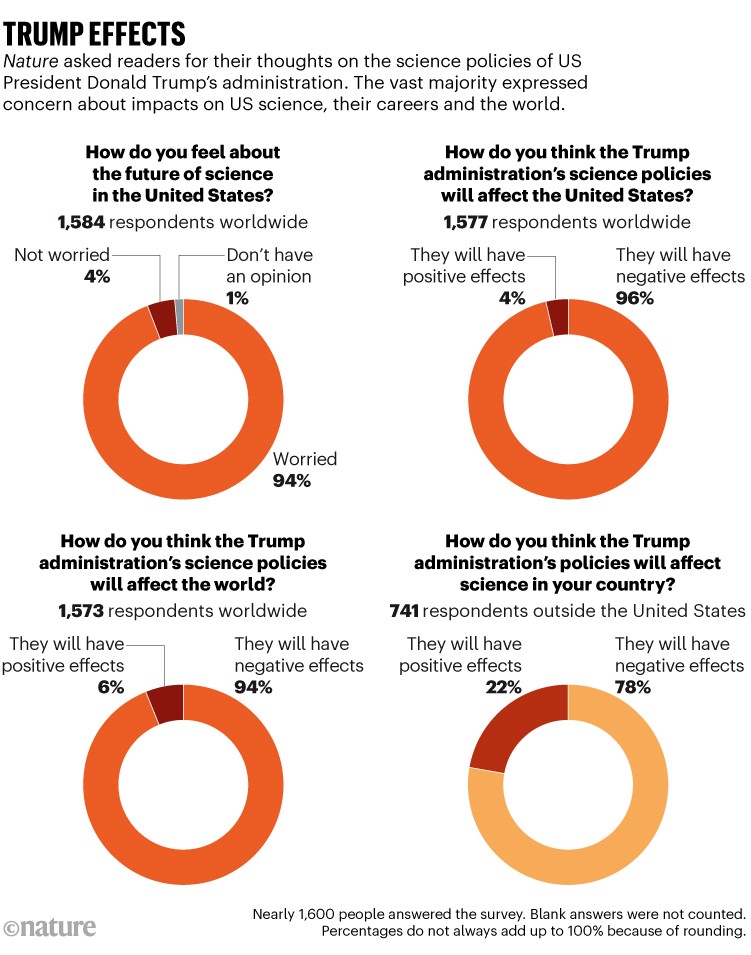
In a survey of Nature readers in April, 94% of nearly 1,600 respondents said they are worried about the future of science in the country. And the same proportion said the Trump administration’s science policies will have negative effects on the world. Although the poll did not include a statistically representative sample, it presents a window onto the concerns of a broad array of researchers (see ‘Trump effects’).
Damage caused by the Trump administration, science-policy experts warn, could set the United States back for decades. “So many of the damaging impacts are going to be extremely difficult to reverse and are going to take a very long time to recover from,” says John Holdren, a science adviser to former US president Barack Obama who is now a science-policy specialist at the Harvard Kennedy School in Cambridge, Massachusetts.
Presidential plans
The United States became the pre-eminent science superpower in the wake of the Second World War through sustained federal investments in research and development. This led to innovations and technology that are integral to modern life, such as the Internet, Google’s search engine, GPS and magnetic resonance imaging (MRI). In 2024, the federal government spent about US$200 billion on research and development, with roughly half of that going to defence-related work.
The largest piece of the pie in non-defence science funding — nearly $48 billion — goes to the National Institutes of Health (NIH), sometimes called the crown jewel of US science, which typically awards more than 60,000 research grants per year. As one measure of its impact, the NIH supplied funding that contributed to more than 99% of drugs approved in the United States from 2010 to 2019 (E. Galkina Cleary et al. JAMA Health Forum 4, e230511; 2023).
In the lead-up to his inauguration, Trump said that his administration would “unleash scientific breakthroughs, ensure America’s technological dominance, and usher in a Golden Age of American Innovation!” His Department of Government Efficiency, headed by billionaire Elon Musk, has justified its sweeping terminations of funds and mass firings at agencies such as the NIH as efforts to root out waste, fraud and abuse, although it has not presented evidence of such.
Many of the administration’s actions mirror suggestions made in Project 2025, a blueprint for a second Trump presidency developed by the conservative Heritage Foundation think tank in Washington DC. One of its four central objectives is to “dismantle the administrative state”, which includes thousands of workers at agencies such as the NIH, the National Science Foundation (NSF) and the Environmental Protection Agency. Project 2025’s authors accuse these federal workers of waste, corruption and “woke propaganda” — language that the Trump administration has used to explain its actions.
Some conservatives have long questioned the value of federal investments in fundamental research, and these views have gained traction with some modern technology industrialists, says William Press, a computer scientist at the University of Texas at Austin. The idea that the private sector can pick up the slack has gained ground as the Trump administration works to scale back public investments in science. Press calls it a risky experiment. “There’s going to be a lot of roadkill.”
A spokesperson for the White House Office of Science and Technology Policy told Nature that the president has “outlined the administration’s science and technology priorities to ensure American dominance continues into the next generation”.
But dozens of scientists interviewed by Nature since Trump’s inauguration say the administration’s actions are dismantling US science rather than improving it. “It’s not that there aren’t things that you can do to improve how science is funded,” says Pamela Herd, a sociologist at the University of Michigan in Ann Arbor, who studies health policy and bureaucracy. What the Trump administration is doing risks killing “the golden goose” that is US science, Herd says.
“The irony,” she says, “is that mostly what that will do is just increase the risk for fraud, waste and abuse.”
In some agencies, the intent seems to be to “cut until they can no longer deliver on their mission”, says Rachel Cleetus, a climate-policy researcher at the Union of Concerned Scientists in Cambridge, Massachusetts. She points to lay-offs at the National Weather Service (NWS), which have hindered its operations and forecasting capabilities. If the NWS could not function, it would then be easier to dissolve the agency altogether, which would open the door for private weather services to take its place, says Cleetus. “They want to privatize a lot of these essential public goods.”
But massive, cost-intensive fundamental research is unlikely to be replaced, policy experts warn. “No one has the capacity of the federal government,” Herd says. “You’re producing research, but you’re also training the next generation of scientists. Private industry can’t do that.”
In particular, the government provides crucial funds for fundamental research that aims to build knowledge but is not necessarily conducted with a practical application in mind (see ‘Innovation spending’). Such research can be years or even decades away from seeding a new technology, and many fundamental-science studies will never reach that point, says Ufuk Akcigit, an economist at the University of Chicago in Illinois. This makes it risky for companies to invest at such an early stage. Instead, they often wait until a discovery’s application becomes clear and then fund the final stages of development, he says.
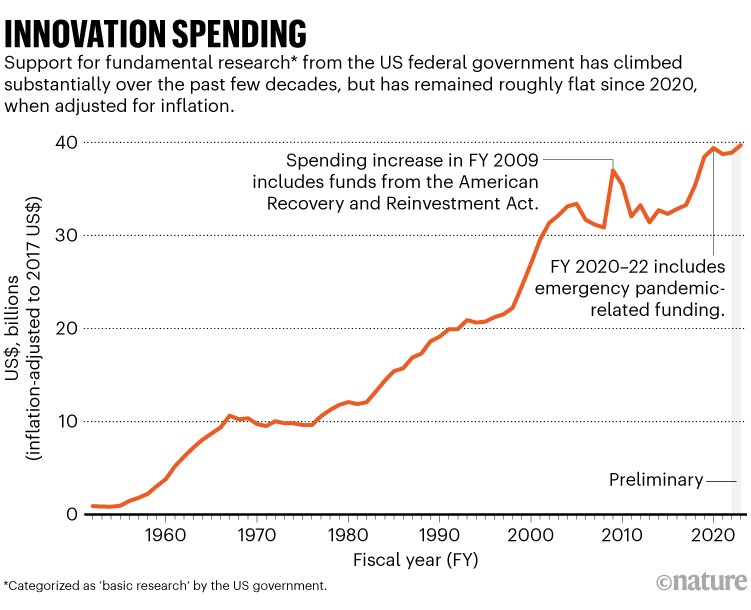
Source: Natl Center for Science and Engineering Statistics (https://go.nature.com/4JTAN8F)
Gutting federal science
One of the clearest and most immediate actions the Trump administration has taken to reshape science has been to slash the vast network of scientists and experts who work for the federal government. As of 2020, around 280,000 scientists and engineers were part of the 2-million-strong federal workforce that is now being downsized. In its first three months, the Trump administration has cut many thousands of jobs from science agencies such as the NIH, the Centers for Disease Control and Prevention (CDC), the Food and Drug Administration (FDA), the National Oceanic and Atmospheric Administration and the National Institutes of Standards and Technology, although exact figures are difficult to tally because the departments have not released the numbers.
On its own, the Department of Health and Human Services, which includes the NIH, CDC and FDA, announced that it would terminate about 10,000 employees. Many of those who have been fired from science agencies are researchers or staff who support research. In discussions of the 2026 budget, the president and Congress have vowed to make even larger cuts to the federal workforce.
Government scientists are accustomed to budget swings and downsizing efforts, but scholars say the degree of hostility and the sheer scale of the potential workforce cuts make this time different.
Researchers interviewed by Nature say that it takes time to train a new generation of recruits, in part because of the unique institutional realities that come with being a government scientist: researchers need to understand government procedures as well as the administrative and statutory context for their work. “The destruction is so pervasive and severe that it’s just not going to be possible to go back to the way things were,” says Blake Emerson, an administrative-law researcher at the University of California, Los Angeles.
“The thing people need to understand about the long term is that when you fire people and when you dismantle projects, you can’t recreate that the moment you have a new administration,” Holdren says. “You’ve lost the momentum. You’ve lost the knowledge, and rebuilding it can take years to decades.”
Attacks on universities
Universities across the country are reeling as they grapple with a barrage of aggressive moves by the government, including federal investigations, threats of massive funding cuts, cancellation of research grants, orders to eliminate diversity initiatives and arrests of some foreign-born students and scholars. Although the government has not released full information about grant terminations, researchers have tallied more than 1,000 so far at just the NIH, the NSF and NASA.
At risk from all of these changes, say researchers, is not just a generation of scientists but the future of the decades-long partnership between government and higher education, which was designed to promote science and foster innovation for the public good. In 2023, US universities spent about $109 billion on research and development, with almost $60 billion coming from the federal government.
“There is a very real question about whether the current system of US research universities will remain intact at the end of this year,” says David Goldston, who retired in April as head of the Massachusetts Institute of Technology’s government-relations team in Washington DC, and previously worked on science issues as a staff member for the US Congress. He says US science is built on the long-standing belief that the country is a stable and welcoming place to do research. “Once you break that spell, it’s gone,” Goldston says — and it won’t magically reappear after another election.
One of the biggest tests will come in the next few months, as Congress takes up the Trump administration’s proposal for the 2026 budget, which is all but certain to call for unprecedented cuts in investments in federal science and innovation. During the first Trump administration, Republicans joined Democrats in defending against large-scale cuts to science, but the current Republican majority has so far fallen in line with Trump’s policies and priorities.
“The notion that the private sector will magically step in to replace government funding for science has been shown to be completely and empirically wrong,” says Robert Atkinson, an economist and president of the Information Technology and Innovation Foundation, a science-policy think tank in Washington DC. Atkinson says the Trump administration’s end game seems to be a federal science establishment that is 30–40% smaller than that of today, “and it just doesn’t matter to them what the effects of that might be on science, innovation, competitiveness and economic growth.”
It is not yet clear what the size of the 2026 federal science budget will be, but research universities could also suffer greatly on other fronts, says Tobin Smith, vice-president for science policy and global affairs at the Association of American Universities (AAU), which represents dozens of the nation’s leading higher-education institutions and is headquartered in Washington DC. Smith points to a number of proposed changes to funding that would substantially reduce the ability of universities to do research, such as reductions in the indirect costs that the government covers so that universities can implement federal grants awarded to academic researchers.
At the same time, Smith says, the Trump administration has taken the view that federal funding for universities is a privilege that should be extended only if institutions adhere to certain political demands. It has cancelled or suspended billions of dollars in grants and contracts to universities including Harvard, Columbia, Princeton, Cornell, the University of Pennsylvania and others over political issues such as student protests and transgender athletes. At least one institution has now pushed back: Harvard University leaders announced on 14 April that they would not comply with demands from the Trump administration, which hours later said that it would freeze $2.2 billion in grants to Harvard. The university is currently suing the Trump administration.
All of this represents an unprecedented threat to universities and their bottom lines, say many research leaders. “The withdrawal of research funding for reasons unrelated to research sets a dangerous and counterproductive precedent,” the AAU board said in a statement in late March.
Christopher Eisgruber, president of Princeton University in New Jersey, warned about the threats to universities and the contributions they provide in an article in The Atlantic magazine: “The Trump administration’s recent attack on Columbia University puts all of that at risk, presenting the greatest threat to American universities since the Red Scare of the 1950s. Every American should be concerned.”
“I think there will be a downsizing of the amount of research that our universities can do in some critical areas that support national interests and needs,” says Smith. “And if we have weaker universities, are we placing in jeopardy our ability as a nation to compete internationally?”
With the cancellation of many research grants and the threat of future cuts, some universities have already cut back on the number of graduate students they are accepting for next year. And the NSF reduced the number of graduate fellowships it awarded this year by half.
There are also signs that the United States is becoming a less appealing place for scientists to study and work. International students accounted for 39% of the PhDs granted by US academic institutions in science and engineering in 2023, but science leaders warn that could change quickly if the United States loses its reputation as a politically stable country that supports science and is open to foreigners.
“My biggest concern is for the pipeline of talent,” said Marcia McNutt, president of the National Academy of Sciences, in an article on the institution’s website. Budget and workforce cuts could result in fewer domestic students being trained, she says, and top researchers from abroad would be less likely to pursue studies and careers in the United States. “Instead, the brain drain will go the other way,” she says.
That brain drain could include Elise Dietmann, a post-baccalaureate researcher at the University of Wisconsin–Madison working in cancer genomics, who is now unsure about her plans. “I want to go to school in the US,” she says. “But now that everything is happening, I’m focusing a lot of my efforts into looking at grad schools abroad.”
Her comments match what Nature found in its poll of readers. More than 80% of roughly 750 scientists outside the United States said the current political situation makes them less likely to consider pursuing science there. And two-thirds of 825 scientists living in the United States said they were less likely to recommend that students pursue a career in US science. The survey also suggests that foreign scientists in the country are looking at other options; 84 out of 92 people who are not US citizens or permanent residents say the current political situation makes them more likely to consider leaving to study or work in another country (see ‘Troubled future’).

Source: Nature analysis of survey data, April 2025
They might find doors opening elsewhere. Several nations, including some in Europe, are planning to recruit scientists from the United States.
Science, stopped
A precipitous drop in federal research funding could have huge implications for the country’s capacity for technological innovation, and the industries and people who rely on it.
When researchers are forced to shift from government funding to industry support because of cuts in federal research spending, those scientists end up filing more patents but publishing less often and launching fewer companies than before (T. Babina et al. Q. J. Econ. 138, 895–954; 2023). “Other sources of funding are not good substitutes for government funding,” says Sabrina Howell, who studies innovation at the Stern School of Business at New York University in New York City.
Neither charities nor individual states have the funds to fill the gap, says Jonathan Thomas, chief executive of the California Institute for Regenerative Medicine, a state funding agency in South San Francisco that supports research into cell and gene therapies. And alternative sources of funding are typically unable to accommodate large, expensive research facilities such as powerful synchrotrons and large telescopes, which require sustained federal support, says Cynthia Friend, chief executive of the Kavli Foundation in Los Angeles, California, which funds fundamental research in fields including astrophysics and neuroscience.
Such a shift could also reduce research in areas that society values but that are unlikely to turn a profit, such as treatments for childhood cancers. Only about 1% of all cancers in the United States occur in people under the age of 20.
“No company is going to make money off of developing a drug for paediatric cancer,” says Douglas Hawkins, a paediatric oncologist at Seattle Children’s Hospital in Washington.
Eventually, the impact will be felt across many industries, as technological breakthroughs fuelled by fundamental research begin to dry up, says Akcigit. “Without these initial fundamental discoveries, we cannot develop new technologies,” he says.
Some researchers and science leaders warn that other countries will pull ahead of the United States in developing crucial innovations. “If our country’s research enterprise is dismantled, we will lose our scientific edge. Other countries will lead the development of novel disease treatments, clean energy sources, and the new technologies of the future,” says the open letter signed by the 1,900 members of the US National Academies.
It will be hard to rebuild US science once it is dismantled, says Bart Gordon, a former Democratic congressman and chair of the US House science committee, who is now a partner at the law firm K&L Gates in Washington DC. “We are at a humpty-dumpty point right now,” says Gordon. “If the legs are kicked out from our innovation machine, then it’s going to be hard to put it back together.”


Comments
Post a Comment